Checklist
AI Mode ads checklist: 20 checks before you spend
A 20-point checklist for Google AI Mode ads, checked against Google’s current help page and 2,036 ads we captured: eligibility, feeds, copy and measurement.
By the AI Mode Ad Library team · Published · Updated · 8 min read
In short
- Start with eligibility: Google says existing Search, Shopping and Performance Max campaigns qualify automatically, while exact and phrase match keywords reach only searches with direct commercial intent, never matches made through the AI’s answer.
- For retailers the feed is the ad: 91% of the 2,036 ads in our capture (Oct 10–11, 2026, US searches) were product listings.
- For everyone else our capture showed at most two text ads per answer, usually under a line Google’s AI wrote, so copy has to work in that setting; one answer with four ads was reported on Nov 4, 2026.
- Set AI Max’s brand, URL and text controls before you switch it on, and check your own brand searches: rivals took 11 of the 16 software and business product-name searches with ads that we ran.
- Google reports AI Mode only in aggregate, so measure with an AI Max experiment, lead outcomes from your CRM and a fixed list of searches you check by hand.
On this page · 8 sections
This checklist turns what Google has published about ads in AI Mode, chiefly its help page for ads in AI Overviews and AI Mode, and what we saw in 2,036 ads captured on Oct 10–11, 2026, into checks you can run on an account. Each item says why it matters, with the source or the figure behind it. Work through it before moving budget, and again each quarter: on Oct 28, 2026 alone Google added ten countries and announced ads on follow-up questions in the US. Our guide to Google AI Mode ads covers what the ads look like.
1. Eligibility
Google’s help page says existing Search, Shopping and Performance Max campaigns are automatically eligible for AI Mode, with no new campaign or separate budget. What differs is how they can be matched: directly to a search that already shows clear commercial intent, or contextually to both the question and the AI’s response.
| Campaign setup | Matched to the search | Matched to the AI’s answer |
|---|---|---|
| Performance Max | Yes | Yes |
| Shopping campaigns | Yes | Yes |
| Search with broad match | Yes | Yes |
| Search with AI Max search term matching | Yes | Yes |
| Search with exact or phrase match only | Only when the search shows direct commercial intent | No |
If you still run Dynamic Search Ads, note the dates. Google’s June 2026 update says campaigns using automatically created assets or the campaign-level broad match setting are upgraded to AI Max automatically from September 2026, and Dynamic Search Ads from February 2027. Upgrading earlier lets you set AI Max’s controls yourself instead of inheriting defaults.
- At least one eligible campaign covers your core searches. In our ad capture, searches run in a browser, where the ads on the page are recorded, 196 of 341 short product and keyword searches (57%) showed ads. Full-sentence questions ran only in our answer capture, a second set of searches that recorded the AI answer and the sources it linked, but picked up ads on almost none of them (2 of 323), so their ad rate was not measured. Start with the short searches for your category, then make sure a campaign that can be matched to the AI’s answer covers the longer questions around them.
- That campaign is not limited by budget. Google’s AI Max help page says AI Max “won’t be effective if campaigns are limited by budget” and shows an alert when they are, and its AI Mode help page advises keeping budgets flexible on high-performing campaigns.
- You are planning for the right market. As of Nov 16, 2026, Google lists ads within AI Mode in English in the US, Australia, Canada, India, Kenya, Malaysia, New Zealand, Nigeria, Pakistan (text ads only), the Philippines and Singapore, and says the list may not be exhaustive. It plans to add Brazil, Mexico and the UK in the fourth quarter of 2026, and multiturn ads, on follow-up questions, are launching in the US. Check the list before counting on AI Mode reach in a market.
- Your category can run there. All Google Ads policies apply to these placements. In a LinkedIn reply reported on June 1, 2026, Google’s Ads Liaison said it was “beginning a small test of ads in AI Mode for the healthcare vertical (in the US for English queries)”, and in October 2026 a Google spokesperson told Adweek it was testing standard text and Shopping ads in AI Mode and AI Overviews for certain pharmaceutical products, including prescription drugs, in the US only. We recorded 35 finance and insurance ads in AI Mode; check the policies for your vertical before planning spend.
2. Product data, for retailers
Google says click-through rates are already similar between sponsored and organic product list items within AI Mode, from its internal US data for Aug 20 to Sep 3, 2026. That compares product listings inside AI Mode only, so it is no forecast for text ads and no comparison with the classic results page. What you control is the data behind the listing.
- Your feed is complete and current. Google’s AI Mode help page asks for Merchant Center data that matches your landing pages, with descriptive titles and descriptions, accurate prices and sale prices, product ratings and highlights, and clear shipping and return policies. Shopping and Performance Max campaigns build their product ads from that data, not from keywords.
- You supply enough images. The same page asks for “multiple high-resolution product and lifestyle images”; 1,649 of the 1,857 product listings in our capture (89%) showed a photo.
- Your own name returns your own products. On kastking reel, dxl clothing and thrive market, the product block was almost entirely the brand’s own listings. Search your brand and best-selling product names in AI Mode and see whose cards come back.
3. Text ads and copy
Text ads competed for very little space in our capture. Of the 111 answers with text ads, 68 had two and 43 had one, and none had more. In the ten industries where text ads outnumbered product listings, answers with ads averaged 1.7 ads. On Nov 4, 2026 Search Engine Roundtable reported, from one screenshot, an answer with four ads; Google has not said how common that is. Every check below is about earning one of those few places.
- A headline names what was searched. 69 of the 179 text ads we captured (39%) had every main word of the search in the headline. With so few slots per answer, naming the thing asked for is the simplest edge.
- Each headline part stands on its own. Google shows responsive search ad headlines in different combinations and orders and can show up to three; 161 of our 179 headlines showed two or three parts.
- There is one checkable fact. A starting price, a free tier, a trial, a customer count or a review count. 20 of the 179 ads quoted a price and 16 headlines offered something free; many more used only adjectives.
- The copy reads well after the AI explainer. In 161 of 197 answers with ads, Google’s AI wrote a line leading into them, and 60 of those lines used the word “options”. Google calls these AI explainers and says advertisers can’t write, edit, approve or opt out of them, but that clear, up-to-date website content helps it surface accurate context. See AI Mode ad copy patterns.
- Nothing in the ad is out of date. One ad captured in October 2026 still advertised “New 2024” cruises. Review dates and years with the same care as prices.
4. Controls and brand protection
AI Max widens the searches you match and lets Google write text and choose pages for you. Because AI Max, broad match, Shopping and Performance Max can be matched to the AI’s answer as well as the search, the controls matter: the same settings decide whether you appear on a rival’s name, and what your ad says when you do. Google says existing guardrails such as negative keywords, brand exclusions and asset pinning still apply in AI Mode. Zapier’s “Zapier vs. Make: Pricing & Reliability” on make.com review shows how direct those placements can be.
- Brand settings and negatives are set on purpose. AI Max supports brand inclusions at campaign and ad group level and brand exclusions at campaign level. Decide which rival names you want to appear on, keep negative keywords current, and keep brand campaigns on your own name.
- Landing pages are fenced. Final URL expansion picks the page it predicts will perform best, and pinned assets are not used when it picks a different page. Add URL exclusions for pages you never want as landing pages, and use Google’s text disclaimers for wording that must always appear.
- Text guidelines are in place. The beta allows up to 25 term exclusions and 40 messaging restrictions per campaign, such as “Don’t imply our products are discounted”. Review assets marked “Google AI” in the asset report.
- You have checked your own brand searches. Of 16 searches with ads naming a software or business product, the maker advertised on 5; on birdeye and deel review only rivals appeared. Search your name with “review”, “alternatives” and “pricing”, and run the brand check.
5. Measurement and monitoring
- You have a baseline and a test. Export search terms, landing pages and assets, then use Google’s one-click AI Max experiment, which splits a campaign 50/50 rather than copying it.
- You wait, then read the right reports. Google advises at least two weeks after enabling AI Max before changes such as negative keywords. Then read match type “AI Max”, the Source column and the “Search terms and ad combinations” view, remembering that AI Mode results are included there in aggregate, with no separate segment described. Details in measuring AI Mode ads.
- Bidding learns from real outcomes. Google’s AI Mode help page recommends Smart Bidding backed by accurate first-party conversion data. For lead generation, import qualified leads or sales, for example with enhanced conversions for leads, since no report separates AI Mode clicks from the rest.
- You look at the placement on a schedule. In our capture 87% of advertisers appeared on only one question, and each question in the ad capture was searched once, so a single check is a single sample. Keep a fixed list of searches, add a follow-up question to the important ones, check it monthly, compare with this library’s industry reports, and sign up for alerts. For organic visibility, keep pages indexed and snippet-eligible and read Search Console’s generative AI report.
Our figures come from one signed-out session per question from US connections, on questions we chose. Use them to decide what to check, not as a forecast of your own results.
Examples from the library
4 of the ads on searches this guide links to, in our capture (Oct 10–11, 2026, US searches). Each card shows the search that brought it.
“You can explore the official Make.com site to see how it works or compare it with other automation tools.”
 Make®Sponsored
Make.com Official Site - Make® Automation Software - Bring Ideas To Life With Make®
Use the #1 visual automation platform to connect apps, design workflows & build processes.
Searched for
Business SoftwareOct 10, 2026“If you're looking for other reputation management platforms, here's an alternative to consider.”
SOCiSponsoredThe Better Alternative - The Better Choice is SOCi
Ready to streamline your multi-location marketing strategy? Schedule a demo today.
Searched for
Small Business ToolsOct 11, 2026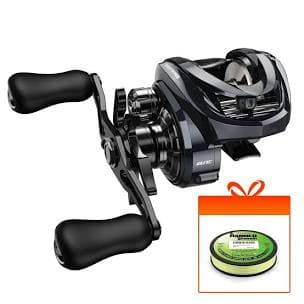 $229.99Product
KastKing Al-Ti Elite Baitcasting Reel | KastKing ALTI Baitcaster Reel | Aluminum Baitcaster Reel 7.2:1 / Right Handed
Searched for
Sports, Outdoor & FitnessOct 11, 2026 $60.00Product
DXL Big & Tall Waist-Relaxer Pleated Twill Pants in Khaki – Men’s Cotton Dress Pants Size 42 x 30
 DXL★★★★½ 4.6 (728)
Searched for
Fashion & FootwearOct 10, 2026

Questions and answers
What do I need to run ads in Google AI Mode?
An existing Search, Shopping or Performance Max campaign: Google says these are eligible automatically, with no separate AI Mode campaign or setting. To be matched on longer questions through the AI’s answer, use AI Max, broad match, Shopping or Performance Max; exact and phrase match keywords only reach searches with direct commercial intent.
Is there a separate budget or bid for AI Mode?
No. Google says these ads use the same auction and the same cost-per-click or conversion-based bidding as other Search ads, with no extra charge. You can’t target AI Mode on its own or opt out separately, and results are included in aggregate in your campaign reports.
What is the most common mistake?
Treating AI Mode like a results page with many ad slots. In our capture an answer held at most two text ads, so weak or generic copy had little room, and rivals often took the slots on brand searches.
How often should I recheck?
At least quarterly. During 2026 Google announced new AI Mode formats, a Direct Offers pilot, AI Brief and new AI Max reporting; its Ads Liaison confirmed small AI Mode tests of healthcare ads and of exact and phrase match; on Oct 28 Google added ten countries and announced ads on follow-up questions in the US; and Dynamic Search Ads are being upgraded to AI Max.
Sources
- About ads in AI-powered experiences in Google Search – Google Ads Helpsupport.google.com
- Ads in AI Mode expand to new marketsblog.google · Oct 28, 2026
- A new generation of ads for the AI era of Searchblog.google · May 20, 2026
- Google Begins Limited Test Of Healthcare Ads In AI Mode – Search Engine Roundtableseroundtable.com · Jun 1, 2026
- Google Ads Tests Serving Search Ads With Restrictive Match Types In AI Mode – Search Engine Roundtableseroundtable.com · Sep 4, 2026
- Google Opens AI Mode to Prescription Drug Ads – Adweekadweek.com · Oct 12, 2026
- Google AI Mode Now With Up To Four Ads – Search Engine Roundtableseroundtable.com · Nov 4, 2026
- We’re upgrading Dynamic Search Ads to AI Max (updated June 11, 2026)blog.google · Apr 15, 2026
- AI Max Turns 1 with new ways to steer performance and expansion to more advertisersblog.google · Apr 30, 2026
- How AI Max for Search campaigns works – Google Ads Helpsupport.google.com
- Use text guidelines with Performance Max and Search campaigns (beta) – Google Ads Helpsupport.google.com
- About responsive search ads – Google Ads Helpsupport.google.com
- About Shopping ads – Google Ads Helpsupport.google.com
- About reporting in AI Max for Search campaigns – Google Ads Helpsupport.google.com
- About the “Experiments” page – Google Ads Helpsupport.google.com
- AI features and your website – Google Search Centraldevelopers.google.com · Dec 10, 2025
Figures from the library are in our capture (Oct 10–11, 2026, US searches) and describe what we observed, not Google’s full ad inventory. AI Mode Ad Library is independent and not affiliated with Google.